
| What you need to know 1- Bonus depreciation lets you deduct the cost of qualifying business and rental property in year one instead of over many years. 2- As of October 2026, the deduction is a permanent 100% for property acquired after January 19, 2025, according to the IRS. 3- Qualifying property includes equipment, software, qualified improvement property, and the short-life parts of a building that a cost segregation study identifies. 4- Your contract date can decide whether you get 100% or an older, lower rate. The deduction is automatic unless you elect out, and it can backfire if you lack income to use it or plan to sell soon. |
Bonus depreciation is a federal tax rule that lets you deduct most or all of a qualifying asset’s cost in the first year you use it, instead of spreading the deduction over many years. Since the One Big Beautiful Bill Act, that first-year deduction is 100% again and no longer scheduled to expire.
For a business owner buying equipment, that can turn a large purchase into a large deduction this year. For a landlord or building owner, it works best alongside real estate cost segregation analysis, which finds the parts of a building that qualify.
Here is our honest take: 100% bonus depreciation is a timing tool, not free money. Before you buy, check that you can use the deduction this year and that a sale will not claw it back.
What is 100% bonus depreciation and how does it work?
100% bonus depreciation, formally the additional first-year depreciation deduction under Section 168(k), lets you deduct the full cost of qualifying property in the year you place it in service. Without it, you recover the same cost slowly through MACRS (the Modified Accelerated Cost Recovery System, the IRS’s standard schedule of depreciation lives).
Normally the tax code makes you claim a $100,000 truck in yearly slices, like paying off a car in installments. Bonus depreciation lets you take the whole deduction up front, which is why it counts as accelerated depreciation (depreciation faster than the standard schedule).
As of October 2026, the IRS says the One Big Beautiful Bill Act created “a permanent 100-percent additional first year depreciation deduction” for property acquired after January 19, 2025. The agency’s January 14, 2026 news release accompanied IRS Notice 2026-11, its interim guidance on how the rules work.
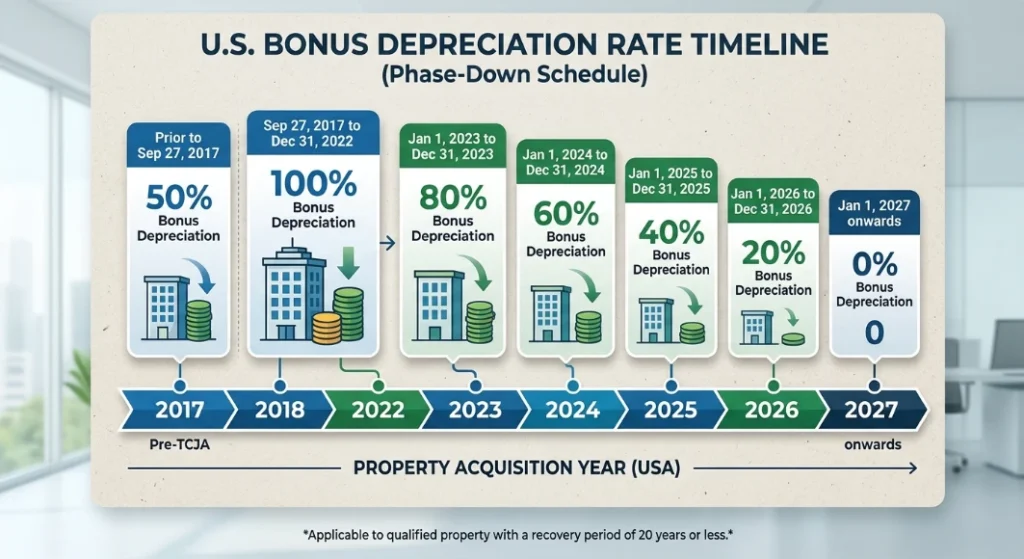
Some guides still describe a phase-down to 20% in 2026. That schedule came from the Tax Cuts and Jobs Act and does not govern property acquired after the cutoff. For the bigger picture, see how the new tax laws and tariffs affect business owners.
What property qualifies for bonus depreciation?
Qualifying property is generally tangible business property with a recovery period of 20 years or less, plus certain software, according to BPM’s analysis of the IRS guidance (published January 2026). The main categories look like this:
- Equipment and machinery: production tools, restaurant equipment, and similar assets with 5 or 7-year lives.
- Vehicles and software: business vehicles (subject to IRS limits) and off-the-shelf software.
- Qualified improvement property (QIP): improvements to the inside of an existing nonresidential building, which BerryDunn lists as eligible.
- Short-life building parts: the 5, 7, and 15-year components that a cost segregation study separates from the structure.
Used property can qualify too. Neither you nor a predecessor may have used it before, and you cannot buy it from a related party, per BerryDunn’s February 2026 guide. The building structure itself (27.5 or 39-year property) and the land do not qualify.
A newer category, qualified production property, covers the part of a factory used for manufacturing, production, or refining.
Construction must begin after January 19, 2025 and before January 1, 2029, and the building must be placed in service after July 4, 2025 and before January 1, 2031, per BDO’s March 2026 review of IRS Notice 2026-16. Offices, parking, and lodging space do not count.
Does the January 19, 2025 cutoff change your bonus depreciation rate?
Yes. Your rate depends on when you acquired the property, and the IRS treats that as the date you signed a written binding contract to buy it.
A binding contract counts only if it is enforceable under state law and does not cap damages at a set amount, per PwC’s January 2026 analysis. If either side can cancel without a substantial penalty, the contract is not binding yet.
For property you build yourself, a safe harbor treats construction as started once you have paid or incurred more than 10% of the total cost, excluding land and early planning.
Property acquired on or before January 19, 2025 stays under the older phase-down. Equipment ordered in late 2024 and placed in service in 2025 generally falls under the 40% rate instead of 100%.
How much can 100% bonus depreciation save you?
The savings equal the extra first-year deduction multiplied by your tax rate. Say you run a landscaping company and buy $500,000 of 7-year equipment, all placed in service in 2026. These numbers are hypothetical.
| Year one | 100% bonus depreciation | Elect out (regular MACRS) |
|---|---|---|
| Deduction | $500,000 | $71,450 |
| Federal tax saved at 32% | $160,000 | $22,864 |
| Deduction left for later years | $0 | $428,550 |
The regular schedule uses the 14.29% first-year rate for 7-year property under the half-year convention, from IRS Publication 946. You deduct the same $500,000 in total either way, so the difference is when you get the cash.
This ignores state tax, Section 179, and the mid-quarter convention, and it assumes you have enough income to use the full deduction.
| Planning a big equipment or property purchase this year? Our team can model the deduction before you sign, starting with our small business tax planning work. |
Bonus depreciation or Section 179: which one fits?
Section 179 lets you expense qualifying equipment up to a dollar cap, while bonus depreciation has no cap and applies to a whole class of property. The right mix depends on your income.
| Feature | Bonus depreciation | Section 179 |
|---|---|---|
| 2026 dollar limit | None | $2,560,000, phasing out above $4,090,000 of purchases |
| Limited by taxable income | No | Yes |
| Choose asset by asset | No, applies to a whole class | Yes |
| Can create a net operating loss | Yes | No |
The limits come from section179.org (updated June 2026). The income and asset-by-asset points come from Fit Small Business.
Section 179 applies first, and bonus depreciation covers the remaining basis, as Xero’s August 2026 guide explains.
How do business owners use bonus depreciation?
Business owners use it mostly on equipment, vehicles, software, and tenant build-outs. Three rules keep it clean:
- Place it in service by year end. “Placed in service” means ready and available for use, so equipment that arrives in January belongs to next year.
- Watch vehicle caps. For 2026, the first-year limit for a passenger car with bonus is $20,300, per Rev. Proc. 2026-15 as reported by the Journal of Accountancy. Heavy SUVs carry a $32,000 Section 179 cap.
- Know your entity. In an S corporation, partnership, or LLC, the deduction passes through to your personal return (see our S corporation tax strategies).
Our small business tax strategy guide shows where bonus depreciation fits among your other deductions.
How do property owners use bonus depreciation?
Property owners usually reach it through four routes:
- Cost segregation: a study reclassifies parts of a building into 5, 7, and 15-year categories so they qualify. That is why our cost segregation service and bonus depreciation are usually paired.
- Qualified improvement property: interior renovations to a commercial building can qualify without a study.
- Short-term rentals: owners who materially participate in a short-term rental may be able to use the resulting loss against other income.
- Look-backs: if you never claimed bonus depreciation on a property you own, Form 3115 can catch up the missed deduction.
A missed-depreciation catch-up is a Section 481(a) adjustment, and a negative adjustment is taken entirely in the year of change, per NATP’s August 2026 explainer. Commercial owners can also review commercial property tax savings strategies.
When should you elect out of bonus depreciation?
Bonus depreciation is automatic, so you must act to avoid it, and sometimes you should. You can elect out by class of property, and the election is generally irrevocable, per BDO. Consider it in these cases:
- You lack the income. A large deduction can create a net operating loss, and BerryDunn notes that later NOL use is capped at 80% of taxable income.
- You would waste credits. Nonrefundable credits go unused when taxable income drops to zero.
- Loss limits apply. Passive activity rules can suspend rental losses, as LaPorte explains. The 2026 excess business loss cap is $256,000 ($512,000 joint), per Spidell, citing Rev. Proc. 2025-32.
- A sale is coming. Gain up to the depreciation claimed on Section 1245 property is taxed at ordinary income rates, per EisnerAmper.
The one-time 40% election covered only the first tax year ending after January 19, 2025, so for calendar-year filers it applied to 2025. Today your lever is the class-by-class election out.
Model the deduction against your income during the year with quarterly tax planning, and plan any sale early through liquidity event planning.
Bonus depreciation FAQs
Is bonus depreciation permanent now?
Yes, for property acquired after January 19, 2025. The One Big Beautiful Bill Act made the 100% deduction permanent, and the IRS confirmed it in Notice 2026-11 on January 14, 2026. Permanent means no scheduled expiration, but Congress can still change tax law, so check the rules in effect when you buy.
Can you use Section 179 and bonus depreciation on the same asset?
Yes. Section 179 applies first, up to the 2026 cap of $2,560,000, and bonus depreciation covers the remaining basis. Section 179 is limited by your business income and can be chosen asset by asset, while bonus depreciation has no income limit. Your CPA can choose the mix that fits your income.
Does bonus depreciation apply to used property?
Yes, if neither you nor a predecessor used the property before and you did not acquire it from a related party. Property bought from a family member or a related entity generally fails the test. Confirm the seller and the property’s history before you claim the deduction.
How do you claim bonus depreciation on your tax return?
You report it on Form 4562, Depreciation and Amortization, in the part for the special depreciation allowance, then carry the total to your business or rental return. The deduction is automatic unless you attach a statement electing out for a property class to a timely filed return.
Do all states follow federal bonus depreciation?
No. A Council On State Taxation chart dated December 31, 2025 shows Missouri following the federal rules, while California, New York, and Pennsylvania decouple. Where a state decouples, you depreciate more slowly for state purposes, and your state tax bill rises. Check state conformity for both your business and personal returns before counting on the full savings.
The bottom line: use the timing, check the limits
100% bonus depreciation pays off when you can use the deduction now and keep the asset. It disappoints when income is thin, losses get trapped, or a sale comes soon.
- Worth using if: you are buying qualifying property, have taxable income to absorb the deduction, and plan to hold the asset for years.
- Consider electing out if: you would create a loss you cannot use, waste credits, or face a near-term sale.
Not sure which side you are on? Book a strategy call with our team and we will walk through your purchase, your income, and your exit plan. Our proactive tax planning work settles these questions with numbers instead of guesses.
This article is general information, not tax or legal advice. Tax rules change, and results depend on your facts, so confirm the details with a qualified CPA or tax advisor before acting. The dollar figures in the example are hypothetical.
